Waterproofing
5 signs your HDB bathroom needs re-waterproofing
Waterproofing doesn’t last forever. In older HDB flats especially, the membrane beneath your bathroom floor gradually breaks down, and once it fails, water starts seeping into the structure — and often into the unit below. Catching the warning signs early is the difference between a contained repair and a major, costly job (not to mention a very unhappy neighbour). Here are the five signs it’s time to re-waterproof, and what the work actually involves.
Key takeaways
- Ceiling stains in the unit below are the clearest warning sign — act early.
- Watch for a musty smell, hollow or lifting tiles, white efflorescence at grout lines, and recurring corner mould.
- Catching it early usually means a targeted repair rather than a full strip‑out.
- Left too long, water spreads and the fix gets far more expensive.
1. Ceiling stains in the unit below
This is the clearest and most serious sign. Brown rings, damp patches or peeling paint on the ceiling of the unit directly below your bathroom almost always point to a failing waterproofing membrane in your floor. In HDB flats this is known as an inter-floor leak, and it won’t fix itself — the water is tracking through the concrete and will only get worse. If your downstairs neighbour mentions a stain, take it seriously and get your bathroom assessed.
2. A persistent musty smell
If your bathroom has a damp, musty odour that never quite clears no matter how well you ventilate or clean, it’s a sign that moisture is trapped behind the tiles and skirting. A properly waterproofed, well-drained bathroom dries out; one with a failing membrane holds moisture in the screed and walls, and that trapped water produces the smell — and feeds mould.
3. Lifting, cracked or hollow-sounding tiles
Tap gently across your bathroom floor tiles. A solid, consistent sound is good; a hollow sound, or tiles that are lifting at the edges or cracking for no obvious reason, means water has got underneath and weakened the bond between the tile and the screed. Once tiles start lifting, water has an even easier path down, and the problem accelerates.
4. White, chalky residue at grout lines (efflorescence)
Those white, powdery or crystalline deposits that appear along grout lines aren’t just a cleaning problem — they’re efflorescence, salts left behind as water moves through the screed and evaporates at the surface. It’s a visible signal that water is actively migrating through the floor structure, which is exactly what waterproofing is meant to prevent.
5. Recurring mould at corners and skirting
Mould that keeps coming back at floor corners, along the skirting, or at the base of walls — even after you clean it off — indicates ongoing moisture that cleaning alone can’t solve. Surface mould from a steamy shower wipes away and stays away with ventilation; mould fed by a failing membrane returns because the moisture source is still there.
Why you shouldn’t just repaint or reseal the surface
It’s tempting to repaint the stained ceiling below or run a bead of silicone around the bathroom and hope for the best. But these treat the symptom, not the cause. The water is getting through the floor membrane, and until that’s addressed, it will keep tracking through — the stain will return, the smell will linger, and the damage will spread. Proper re-waterproofing fixes the source.
What re-waterproofing involves
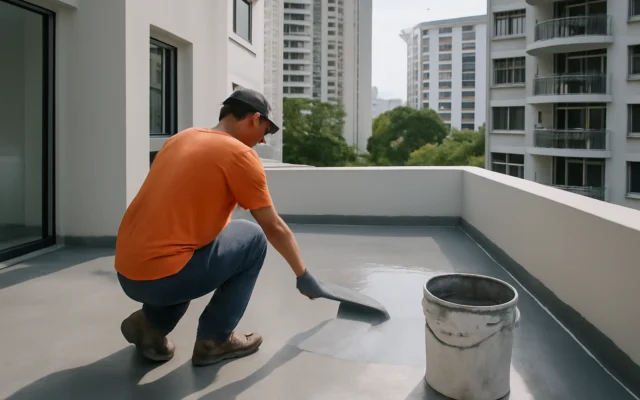
A proper job starts with assessing the extent of the failure. Some cases need only targeted treatment around a floor trap or kerb; others need a full strip-out and re-membrane. The typical process is: hack the affected tiles, prepare and clean the surface, apply a fresh waterproofing membrane with careful detailing at corners, kerbs, floor traps and pipe penetrations (where leaks usually start), allow proper curing time, water-test where appropriate, and re-tile to a clean finish. Good work comes with a workmanship warranty. Most HDB bathrooms are completed within a few days, allowing for drying and curing.
How much does it cost, and how long does it take?
Cost depends on the area, the extent of the failure and whether tiles are hacked — a targeted repair costs far less than a full re-do. The important thing is not to chase the cheapest quote: a proper membrane and a warranty save you from paying twice. For a full breakdown, see our guide on bathroom waterproofing cost in Singapore.
Can you prevent waterproofing from failing?
You can’t make waterproofing last forever, but you can extend its life and catch problems early. Keep floor traps clear so water drains quickly rather than pooling; ventilate the bathroom so it dries between uses; avoid harsh chemicals that degrade grout and sealant over time; and re-seal silicone joints around the shower and basin when they start to peel or blacken, since these are early entry points for water. Most importantly, act on the five signs above the moment you notice them — a small, contained repair is a fraction of the cost and disruption of a full failure that has spread to the unit below.
Frequently asked questions
How long does bathroom waterproofing last? A quality job can last many years, but it depends on the original workmanship, usage and maintenance. Older HDB flats often reach the point where the original membrane has simply aged out.
Do I have to hack all the tiles? Not always. If the failure is localised, targeted treatment may be enough. A proper assessment tells you whether you need a spot repair or a full re-membrane — and an honest contractor won’t push a full hack you don’t need.
My neighbour below has a stain but my bathroom looks fine — is it still me? Possibly. Waterproofing fails beneath the tiles where you can’t see it, so your bathroom can look perfectly normal while water tracks down. An assessment (and sometimes a water test) confirms the source.
Is re-waterproofing covered by HDB? Inter-floor leaks are generally treated as a shared matter between the two households, with the repair typically carried out from the upper unit’s floor. HDB and the Town Council can advise, but the practical fix is re-waterproofing the source.
The bottom line
Ceiling stains below, musty smells, lifting tiles, white efflorescence and recurring mould are your bathroom telling you the waterproofing has failed. Act early, fix the source rather than the symptom, and use a contractor who stands behind the work with a warranty.
Spotting any of these signs? See our waterproofing service, and if there’s a ceiling leak involved, read about inter-floor leaks in HDB flats. Get a free assessment and quote today.