Waterproofing
Ceiling leak in your HDB flat? Understanding inter-floor leaks
Few home problems are as stressful — or as commonly misunderstood — as a ceiling leak in an HDB flat. A wet patch, a brown stain or actual dripping from your ceiling almost always means an inter-floor leak: water from the bathroom or floor of the unit directly above yours is seeping through a failed waterproofing membrane and the concrete slab between your homes. This guide explains what causes it, who’s responsible, how it’s fixed, and what to do if you’re on either side of one.
Key takeaways
- An inter‑floor leak is water passing between your unit and the one below.
- Common sources: failed waterproofing, pipe leaks, or floor‑trap seepage.
- There’s a defined process involving both units and sometimes HDB/BCA.
- Fixing the source — not just repainting the stain — is what stops it.
What an inter-floor leak actually is
Between your flat and the one above is a concrete floor slab. On the upper side, the bathroom floor is (or was) protected by a waterproofing membrane beneath the tiles. Over years of use, that membrane deteriorates — especially around the floor trap, kerbs and pipe penetrations — and water begins to work its way through the slab. It emerges on the underside as a stain or drip on your ceiling. Because the water travels sideways as well as down, the leak can appear a little away from directly beneath the source, which sometimes confuses diagnosis.
What causes it
The most common causes are a deteriorated or aged waterproofing membrane in the upper unit’s bathroom, failed seals around the floor trap and pipe penetrations, and cracked or lifted tiles that let water reach the screed. In older flats, the original waterproofing has often simply reached the end of its life. Less commonly, a plumbing leak in a concealed pipe can mimic an inter-floor leak, which is why proper diagnosis matters before anyone starts hacking.
Who is responsible?
This is the question that causes the most anxiety. Under HDB’s guidelines, inter-floor leaks are generally treated as a shared matter between the two households, on the basis that the ceiling and floor slab is common to both. In practice, because the source is the upper unit’s floor, the repair is usually carried out there. HDB and the Town Council can offer advice and, in some cases, mediation or assistance if neighbours can’t agree — but the practical, lasting solution is always the same: re-waterproof the source. Approaching your neighbour calmly, with evidence (photos, dates), and framing it as a shared problem to solve together tends to go far better than a confrontation.
How it’s diagnosed
A proper diagnosis confirms that the water is coming from the upper unit’s floor and not from a concealed pipe or an external source. This can involve inspecting both units, checking the pattern and timing of the staining, and sometimes a water test — deliberately wetting areas of the upper floor to see what comes through below. Getting this right avoids hacking the wrong thing.
How it’s fixed
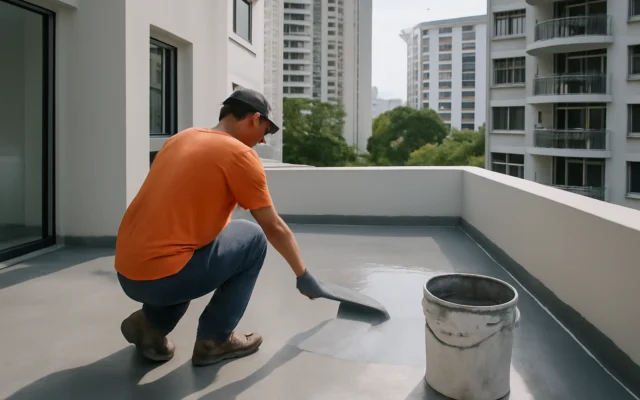
The lasting fix is to re-waterproof the floor in the upper unit — not to repaint the stained ceiling below, which only hides the symptom while the water keeps tracking. The typical process is to hack the affected bathroom floor tiles in the upper unit, prepare the surface, apply a fresh warrantied waterproofing membrane with careful detailing at the trap, kerbs and pipe penetrations, water-test, and re-tile. Once the source is sealed and the slab dries out, the ceiling below can be treated and repainted. Most jobs are completed within a few days, allowing for curing.
What to do if you have a ceiling leak
If you’re the lower unit: document it with photos and dates, place something to catch drips and protect furniture, and speak to your upstairs neighbour early and cooperatively. If you’re the upper unit and a neighbour reports a stain: take it seriously even if your bathroom looks fine — the membrane fails invisibly beneath the tiles — and get it assessed rather than dismissing it, because ignoring it lets the damage (and any dispute) grow.
Frequently asked questions
My bathroom looks perfectly fine — can it still be my leak? Yes. Waterproofing fails beneath the tiles where you can’t see it, so a normal-looking bathroom can still be the source.
Can’t I just repaint my ceiling? Repainting hides the stain temporarily, but it returns because the water source above hasn’t been fixed.
Does HDB pay for the repair? It’s generally treated as a shared matter between the two households; HDB and the Town Council can advise and, in some cases, assist. The repair itself is arranged privately.
How long does the repair take? Usually a few days for the waterproofing and re-tiling, plus curing time before the bathroom is back in use.
The bottom line
A ceiling leak in an HDB flat is almost always an inter-floor leak from a failed membrane above. It’s a shared problem best solved cooperatively, and the only lasting fix is to re-waterproof the source — not to repaint the symptom.
Dealing with a ceiling leak, on either side? See our waterproofing service, and read the 5 signs a bathroom needs re-waterproofing and what it costs. Get a free assessment today.
How to approach your neighbour
Because inter-floor leaks involve two households, how you raise it matters almost as much as the fix. Approach it early and calmly, framed as a shared problem to solve together rather than an accusation — most neighbours are reasonable once they understand it’s a failed membrane, not negligence. Bring evidence: photos of the staining with dates, and ideally the outcome of an assessment identifying the source. If you can’t reach agreement, HDB and the Town Council can offer advice and, in some cases, mediation or assistance. A cooperative approach almost always resolves faster and more cheaply than a confrontational one, since the practical fix — re-waterproofing the upper floor — is the same either way.